


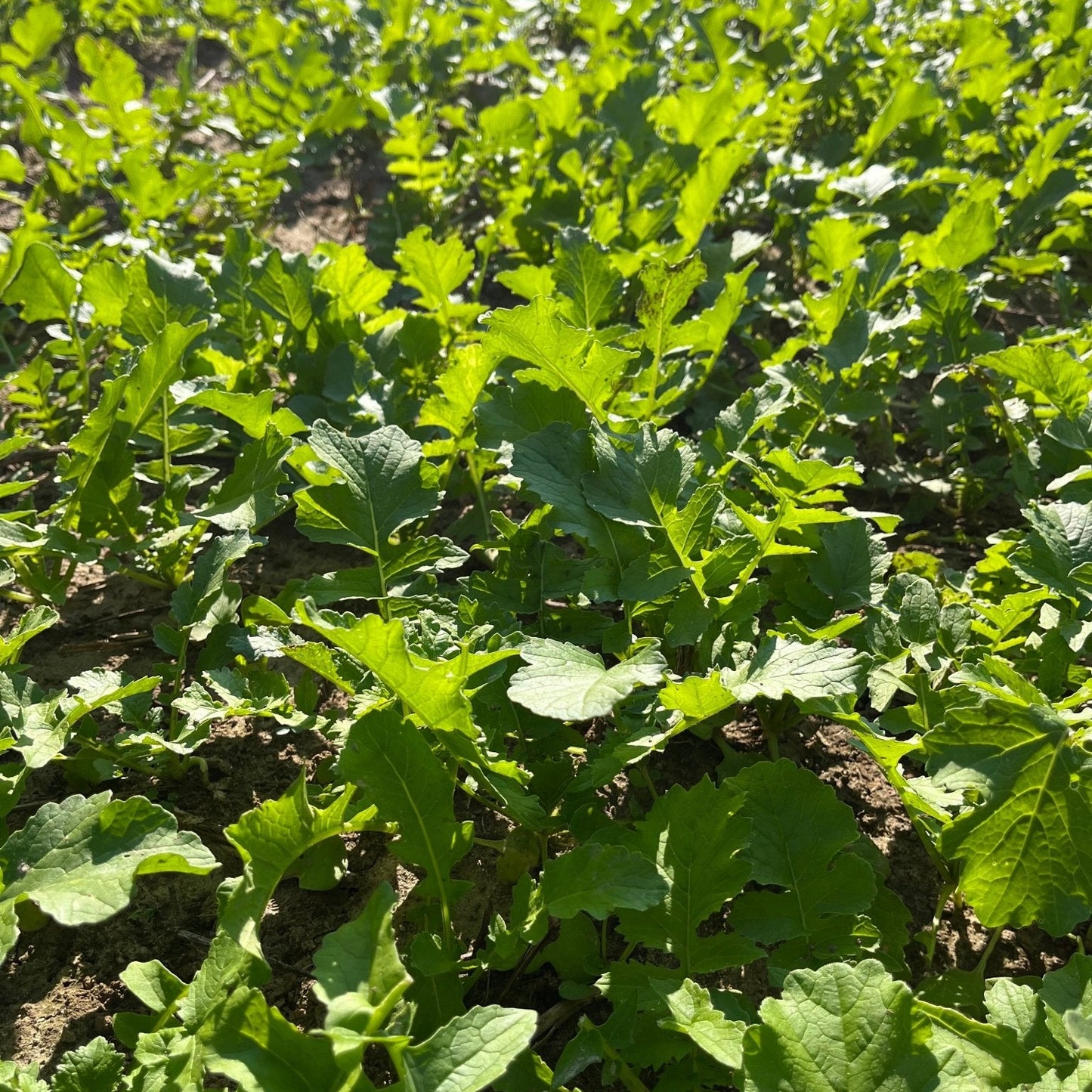

Daikon Radish Seed
Cold-Season Attraction. Soil-Building Performance.
Hale Habitat & Seed’s Daikon Radish Seed (Raphanus sativus) is a powerful cool-season brassica designed to attract deer while dramatically improving soil health. Known for its large, penetrating taproot, daikon radish breaks up compacted soils, scavenges nutrients, and creates ideal conditions for future plantings.
Above ground, lush leafy growth provides highly attractive early-season forage. Below ground, the energy-rich tuber becomes increasingly desirable after frost as starches convert to sugars — making it a late-season draw when other food sources decline.
Whether planted alone or as part of a fall blend, daikon radish delivers both immediate wildlife attraction and long-term soil benefits.
Plant it for the deer. Keep it for the soil.
Benefits for Wildlife
- Highly attractive fall forage for deer
- Becomes sweeter and more palatable after frost
- Provides both leafy forage and energy-rich tubers
- Excellent early bow-season attraction
- Supports herd health during nutritional stress periods
- Can serve as a companion crop in brassica or grain blends
Planting Guidelines
-
Seeding Rate:
- 5–8 lbs per acre (broadcast)
- 3–5 lbs per acre (drilled)
- Planting Depth: ¼–½ inch
-
Best Planting Window:
- Late summer to early fall
- Plant 6–10 weeks before first frost
-
Soil Prep:
- Firm, clean seedbed recommended
- Good seed-to-soil contact is critical
- Sunlight: Full sun preferred
- Moisture: Performs best with adequate fall moisture
Fertilization Guidelines
- Conduct a soil test prior to planting
- Ideal soil pH: 6.0–7.0
- Brassicas respond well to nitrogen
- Apply 40–60 lbs of nitrogen per acre at planting (per soil test recommendations)
- Adequate phosphorus (P) and potassium (K) improve root and leaf development
Herbicide Guidelines
- Use glyphosate or approved burndown herbicide prior to planting
- Ensure complete weed control before establishment
- Avoid broadleaf herbicides post-emergence (radish is a broadleaf plant)
- Grass-selective herbicides may be used if labeled for brassicas
- Early weed competition can reduce bulb development
Frequently Asked Questions
When should I plant Daikon Radish?
How much seed do I need per acre?
How deep should I plant it?
Why is Daikon Radish good for deer?
Will deer eat the bulbs?
Does Daikon Radish improve soil health?
Does it require fertilizer?
Can I mix Daikon Radish with other seeds?
Can I spray weeds after it emerges?
I can’t believe how fast this stuff grows. I just put it down week ago .and it’s coming up. I just can’t wait to the Deer comes this year !

Didn’t get much rain when it was planted, but is still coming up good
We used this seed as a cover crop to help remediate our soil- but we got beautiful radishes out of it!!
I bought these to try and help break up my clay soil over time. I am very pleased. I just scattered them all over a disturbed area topped with a little bit of wood chips I had from some tree trimming and they're growing in abundance with very little input from me. so far so good!
Very simple to get to grow. Literally throw it on your prepped dirt bed. Hand toss it out either during a rain storm or cover it afterward with straw or 1/4 inch of dirt and set back and let Mother Nature do her thing.
The last two years I planted Daikon radishes in very poor soil. I didn't plant until August last year and got a good crop considering the conditions. The deer ate the tops during the warmer weather and later dug the radishes out of the ground until snowcover prevented that. I planted this year and with no rain the radishes still sprouted which surprised me. Daikon radishes are as close to a fail safe food plot as you can get.
Fast germination. Grew great with little rain. Deer won’t leave it alone here in NJ
I have used Hale Habitat's buckwheat seeds and Daikon radish seeds (both were 5 pound bags). I planted buckwheat in June for my honeybees (there is a summer dearth in Georgia). The seeds germinated in a few days and flowered for 2-3 weeks. My bees were ALL OVER the flowers. We harvested the seeds, replanted, and continue to grow it. We just planted Hale's Daikon radish seeds (to amend our hard clay soil) and they germinated in 3 days! I've been very pleased with Hale Habitat's seeds and I highly recommend them.
Fast shipping, fast correspondence , fast germination, strong growth, south east Michigan ground